| |
Tugs at the Port of Swansea. |
| |
Prior to the
introduction of steam tugs in the mid-nineteenth century, sailing ships
entering the Port of Swansea remained totally dependent on the wind and
the tide. The wind was unpredictable, however, and would often leave a
vessel at the mercy of contrary tides and currents, so small ships
approaching the harbour would unship long oars, or ‘sweeps’, to enable the
crew to row the vessel to its berth, while larger ships would put crew
members over the side in rowing boats to tow the vessel into port. Once a
ship was close to land, a line could be taken ashore for men or horses to
pull the vessel upstream, or to be put around a bollard so that the crew
could warp the vessel up to its berth with the ship’s capstan.
Although there
had been trials of steam-powered towing boats for use on inland waterways
in the late 1700’s, one of the first successful examples of a
purpose-built steam-driven tug suitable for tidal waters was probably the
Thames paddle tug ‘Monarch’, built for John Rogers Watkins in 1833. Steam
paddle tugs were certainly in use at Swansea by the 1840’s, and these were
followed by the introduction of screw-driven tugboats in the latter part
of the nineteenth century. The twentieth century saw the development of
larger, more advanced steam tugs and eventually, in the early 1960’s at
Swansea, modern diesel-powered tugs. The towage companies operating at
Swansea during the twentieth century were the Britannia Steam Towing
Company, the Alexandra Towing Company which was taken over by Howard Smith
Towing in 1992, and, in the latter years, the West Coast Towing Company.
These days, all towing activities at Swansea and Port Talbot are carried
out by the international towage and salvage company Svitzer Wijsmuller
A/S. |
|
Brief history of the Alexandra Towing Company |
| |
Founded at Liverpool
in 1887, after the take-over of G B Cowl's towage firm of 1882 and
with the Mack family and Alexander Bicket (Athel Line) among the major
shareholders, the Alexandra Towing Company became one of the major
towage firms on the River Mersey. In 1908 it took over W. & T. Joliffe
& Co. of Liverpool, a tug company founded in 1854, and in 1919 it
followed the Cunard Line's transfer from Liverpool to Southampton |
| |
Notes on Towage – Swansea Docks |
| |
When the GWR took over
Swansea Docks in 1923 it claimed priority over all in-dock towage within the
port, allowing private tug companies to work only when the GWR tugs could
not fulfil operational requirements.
Alexandra
Towing first established its presence at Swansea in 1924 with the tug
“Canada”, which was shortly followed by two more, the “Albert” and the
“Herculaneum”. An office in Somerset Place was opened in 1925.
In 1933, ship
owners won the right to make their own towage arrangements at the port and,
as a consequence, the GWR suffered a serious reduction in the demand for its
in-dock towage services
The last
remaining GWR tug at Swansea, the ‘Trusty’, was transferred to Barry in
1940, when it was agreed that the Alexandra Towing Company should be granted
the right to carry out all towage on behalf of the GWR, subject to a
commission of 7.5% of the towage fee. Shortly afterwards a similar
arrangement was entered into with the Britannia Steam Towing Company, which
had operated at Swansea since 1895.
The two
companies entered into a joint service arrangement in 1962, after which the
Britannia Steam Towing Company was taken over by the Alexandra Towing
Company. Howard Smith Towage took over the Alexandra Towing Company in 1992. |
| |
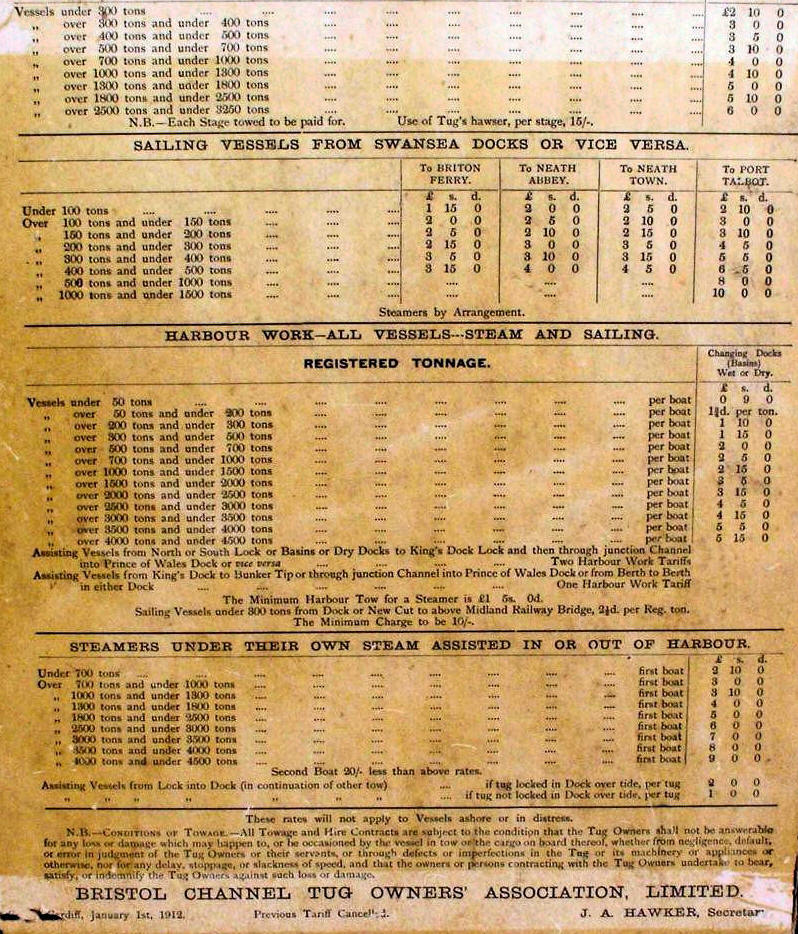
The following are the towing charges for 1912 |
| |
|
| |
|
|
Left to right, David Jones, Gareth Mills,
Patrick Lyons and Cliff Wiltshire. |
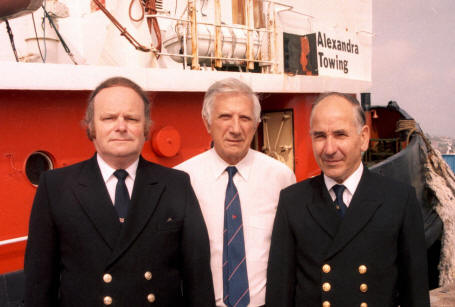
Two Captains retiring Capt Alan Davies, Bernard Sheldon, (Manager) & Capt David Jones |
| |
|
|
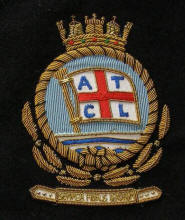
Alexandra Blazer Badge. |
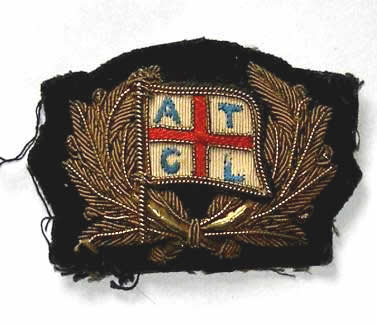
This cap badge belonged to Clifford Jones the father of D Jones pictured
above. He was captain up to 1942 / 1943 |
| |
| |
|
| |
|
| |
|